(UNBURNED, BURNING, BURNED, UNBURNABLE)(UNBURNED, BURNING, BURNED, UNBURNABLE)fireplot and fireplot! work with both LevelSetGrid and CAGrid. Load a Makie backend (e.g. using CairoMakie) to enable them.
The CellularAutomata module implements a deterministic, grid-based fire spread model using a travel-time approach. Each cell occupies one of four discrete states and transitions are governed by directional spread rates from a RothermelModel.
Each cell is in exactly one of four states:
| State | Value | Meaning |
|---|---|---|
UNBURNED |
0 | Fuel available, not yet ignited |
BURNING |
1 | Actively on fire |
BURNED |
2 | Fuel consumed, fire passed |
UNBURNABLE |
3 | Cannot ignite (water, road, fuel break) |
(UNBURNED, BURNING, BURNED, UNBURNABLE)(UNBURNED, BURNING, BURNED, UNBURNABLE)At each time step, three phases occur:
Spread: For each BURNING cell, compute directional spread rate R(θ) to each UNBURNED neighbor. The travel time is distance / R(θ), and the neighbor’s arrival time is updated.
Ignition: Cells whose minimum arrival time has been reached transition to BURNING.
Burnout: BURNING cells whose elapsed time exceeds the residence_time transition to BURNED.
UNBURNED ──(arrival time reached)──▶ BURNING ──(burnout)──▶ BURNED
                                        ▲
UNBURNABLE: never transitions ──────────╳Two neighborhood types control which cells can spread fire:
| Type | Neighbors | Description |
|---|---|---|
Moore() |
8 | Cardinal + diagonal (default) |
VonNeumann() |
4 | Cardinal only |
CAGridThe simulation grid stores per-cell states and ignition times:
grid = CAGrid(100, 100, dx=30.0)CAGrid{Float64} 100×100 (t=0.0, burning=0, burned=0/10000)grid_vn = CAGrid(100, 100, dx=30.0, neighborhood=VonNeumann())CAGrid{Float64} 100×100 (t=0.0, burning=0, burned=0/10000, neighborhood=VonNeumann)xs = xcoords(grid)
println("x: $(first(xs)) to $(last(xs)) m ($(length(xs)) cells)")
ys = ycoords(grid)
println("y: $(first(ys)) to $(last(ys)) m ($(length(ys)) cells)")x: 15.0 to 2985.0 m (100 cells)
y: 15.0 to 2985.0 m (100 cells)ignite!(grid, 1500.0, 1500.0, 100.0)
gridCAGrid{Float64} 100×100 (t=0.0, burning=32, burned=0/10000)burn_area(grid) # m²28800.0count(burning(grid)) # number of actively burning cells32The same RothermelModel used with LevelSetGrid drives the CA simulation. The CA uses directional_speed to compute direction-dependent spread rates to each neighbor, supporting both CosineBlending and EllipticalBlending.
M = FuelClasses(d1=0.06, d10=0.07, d100=0.08, herb=0.0, wood=0.0)
model = RothermelModel(SHORT_GRASS, UniformWind(speed=8.0), UniformMoisture(M), FlatTerrain())

g = CAGrid(100, 100, dx=30.0)
ignite!(g, 1500.0, 1500.0, 100.0)
simulate!(g, model, steps=50)
g
CAGrid{Float64} 100×100 (t=24.100944217000432, burning=572, burned=0/10000)fireplot(g)
M = FuelClasses(d1=0.06, d10=0.07, d100=0.08, herb=0.0, wood=0.0)

fig = Figure(size=(900, 280))
steps_list = [0, 30, 80]
for (col, nsteps) in enumerate(steps_list)
    g = CAGrid(100, 100, dx=30.0)
    ignite!(g, 1500.0, 1500.0, 100.0)
    m = RothermelModel(SHORT_GRASS, UniformWind(speed=8.0), UniformMoisture(M), FlatTerrain())
    nsteps > 0 && simulate!(g, m, steps=nsteps)
    ax = Axis(fig[1, col], title="steps = $nsteps (t = $(round(g.t, digits=1)) min)", aspect=DataAspect())
    fireplot!(ax, g)
    hidedecorations!(ax)
end
fig
using Wildfires.SpreadModels: Trace

M = FuelClasses(d1=0.06, d10=0.07, d100=0.08, herb=0.0, wood=0.0)
g = CAGrid(100, 100, dx=30.0)
ignite!(g, 1500.0, 1500.0, 100.0)
model = RothermelModel(SHORT_GRASS, UniformWind(speed=8.0), UniformMoisture(M), FlatTerrain())

trace = Trace(g, 2)
simulate!(g, model, steps=80, trace=trace)
firegif(joinpath(@__DIR__, "ca_spread.gif"), trace, g)
"/home/runner/work/Wildfires.jl/Wildfires.jl/docs/ca_spread.gif"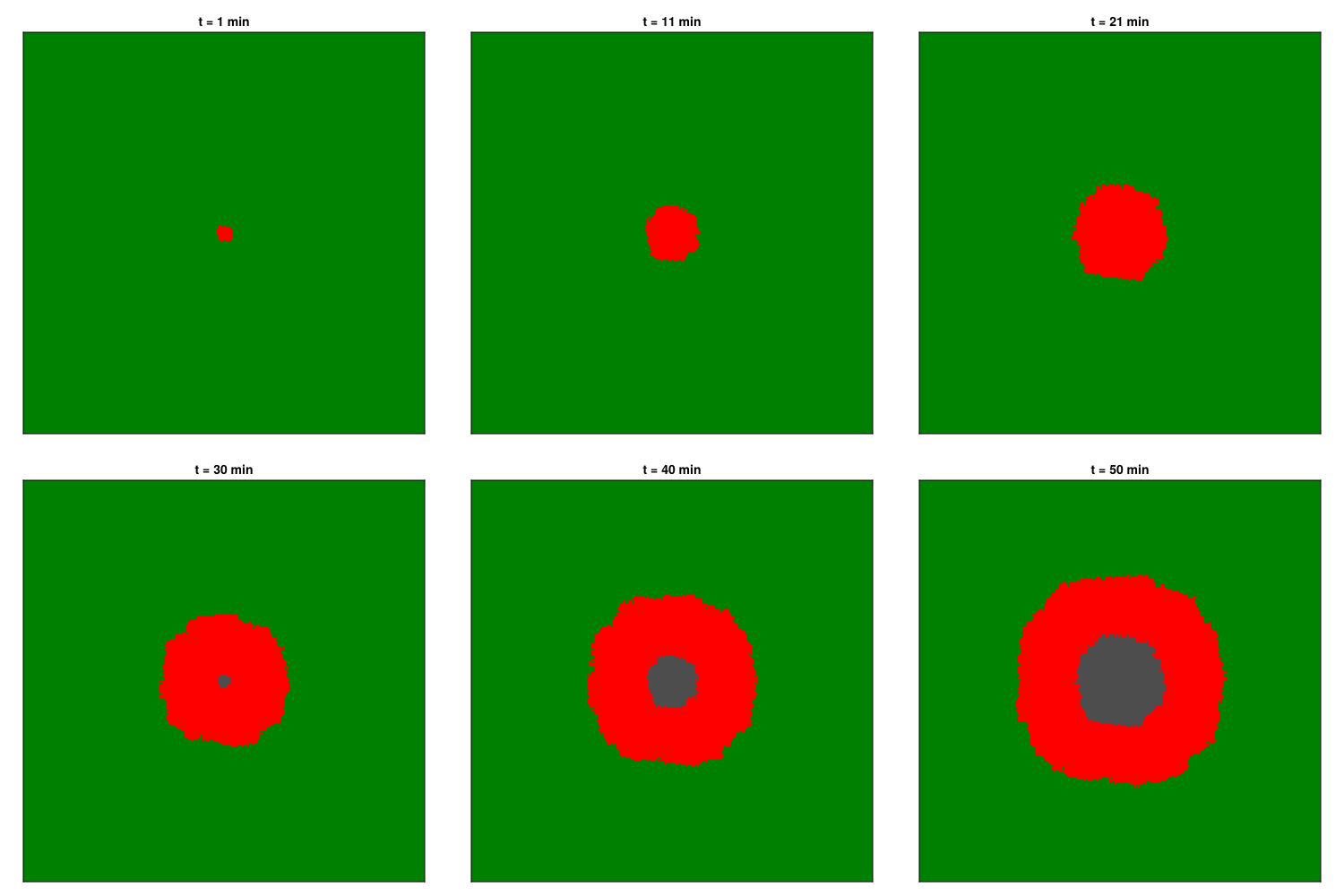
The blending_mode controls fire shape. CosineBlending (default) produces wider fires, while EllipticalBlending gives more realistic elongated shapes:
M = FuelClasses(d1=0.06, d10=0.07, d100=0.08, herb=0.0, wood=0.0)

fig = Figure(size=(700, 300))
for (col, (label, blend)) in enumerate([
    ("Cosine (default)", CosineBlending()),
    ("Elliptical", EllipticalBlending()),
])
    g = CAGrid(100, 100, dx=30.0)
    ignite!(g, 1500.0, 1500.0, 100.0)
    m = RothermelModel(SHORT_GRASS, UniformWind(speed=8.0), UniformMoisture(M), FlatTerrain(), blend)
    simulate!(g, m, steps=80)
    ax = Axis(fig[1, col], title=label, aspect=DataAspect())
    fireplot!(ax, g)
    hidedecorations!(ax)
end
fig
Mark cells as UNBURNABLE to create barriers that block fire spread:
M = FuelClasses(d1=0.06, d10=0.07, d100=0.08, herb=0.0, wood=0.0)
model = RothermelModel(SHORT_GRASS, UniformWind(speed=8.0), UniformMoisture(M), FlatTerrain())

fig = Figure(size=(700, 300))

# Without fuel break
g1 = CAGrid(100, 100, dx=30.0)
ignite!(g1, 1500.0, 1500.0, 60.0)
simulate!(g1, model, steps=80)
ax1 = Axis(fig[1, 1], title="No fuel break", aspect=DataAspect())
fireplot!(ax1, g1)
hidedecorations!(ax1)

# With fuel break (vertical strip)
g2 = CAGrid(100, 100, dx=30.0)
ignite!(g2, 1500.0, 1500.0, 60.0)
xs = collect(xcoords(g2))
for j in eachindex(xs)
    if 2000.0 <= xs[j] <= 2100.0
        for i in 1:size(g2, 1)
            set_unburnable!(g2, xs[j], ycoords(g2)[i], 1.0)
        end
    end
end
simulate!(g2, model, steps=80)
ax2 = Axis(fig[1, 2], title="With fuel break", aspect=DataAspect())
fireplot!(ax2, g2)
hidedecorations!(ax2)
fig
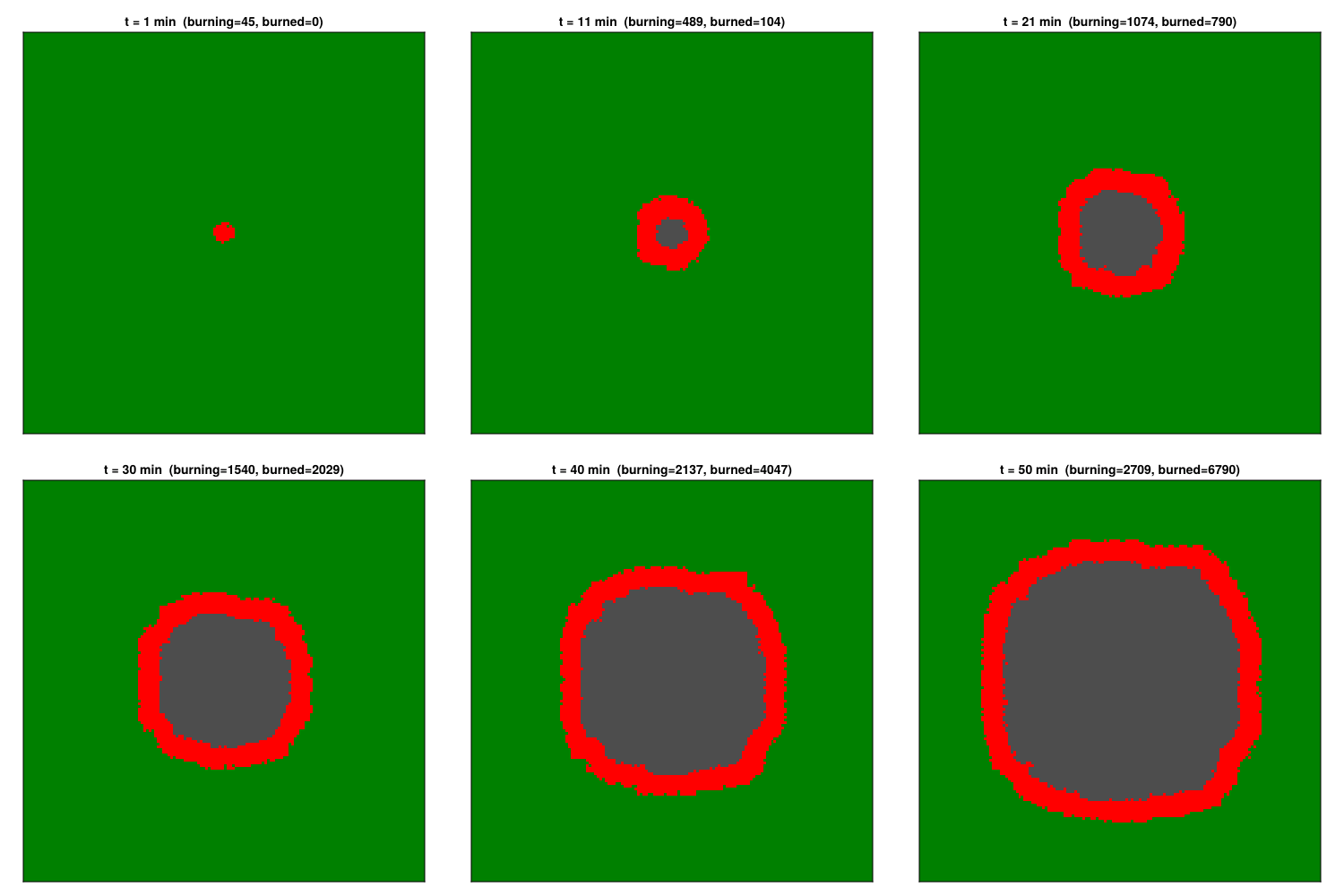
BURNING cells transition to BURNED after residence_time minutes and stop spreading fire. Shorter residence times mean faster burnout:
M = FuelClasses(d1=0.06, d10=0.07, d100=0.08, herb=0.0, wood=0.0)

fig = Figure(size=(900, 280))
for (col, rt) in enumerate([5.0, 15.0, Inf])
    g = CAGrid(100, 100, dx=30.0)
    ignite!(g, 1500.0, 1500.0, 60.0)
    m = RothermelModel(SHORT_GRASS, UniformWind(speed=8.0), UniformMoisture(M), FlatTerrain())
    simulate!(g, m, steps=80, residence_time=rt)
    nb = count(burning(g))
    nd = count(burned(g))
    label = rt == Inf ? "∞" : string(rt)
    ax = Axis(fig[1, col],
        title="residence_time = $label\nburning=$nb, burned=$nd",
        aspect=DataAspect())
    fireplot!(ax, g)
    hidedecorations!(ax)
end
fig
M = FuelClasses(d1=0.06, d10=0.07, d100=0.08, herb=0.0, wood=0.0)
g = CAGrid(100, 100, dx=30.0)
ignite!(g, 1500.0, 1500.0, 60.0)
model = RothermelModel(SHORT_GRASS, UniformWind(speed=8.0), UniformMoisture(M), FlatTerrain())

trace = Trace(g, 2)
simulate!(g, model, steps=80, residence_time=5.0, trace=trace)
firegif(joinpath(@__DIR__, "ca_burnout.gif"), trace, g)
"/home/runner/work/Wildfires.jl/Wildfires.jl/docs/ca_burnout.gif"